


Lace, Reframed: Texture and Contrast for the Modern Wardrobe
Lace has a branding problem. It is still sold as shorthand for romance: bridal, lingerie-inspired, delicate, evening-only and conventionally feminine. Yet the most convincing lace outfits in 2026 are not trying to tell that entire story. They use lace as texture - one porous,
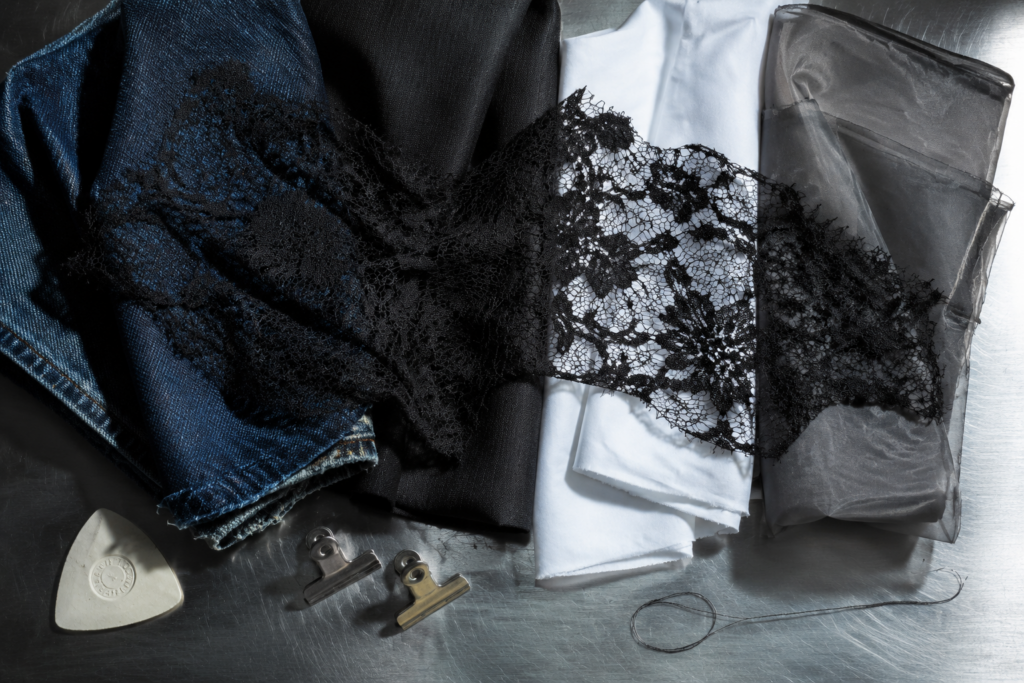
Lace has a branding problem. It is still sold as shorthand for romance: bridal, lingerie-inspired, delicate, evening-only and conventionally feminine. Yet the most convincing lace outfits in 2026 are not trying to tell that entire story. They use lace as texture – one porous, intricate surface placed against something plain, sturdy or familiar. The result is less costume and more contrast.
That distinction matters because romantic dressing is visible again, but shoppers are also more alert to novelty purchases. Vogue’s Summer 2026 trend coverage identified lace and lingerie details within a broader return to femininity, while the Fall/Winter 2026 couture shows made handwork, surface and dimensional fabric central to the season. The runway message is expressive; the wardrobe question is stricter. Can lace work with the jacket, jeans, trousers and shoes a person already owns, or does it require a second fantasy wardrobe around it?
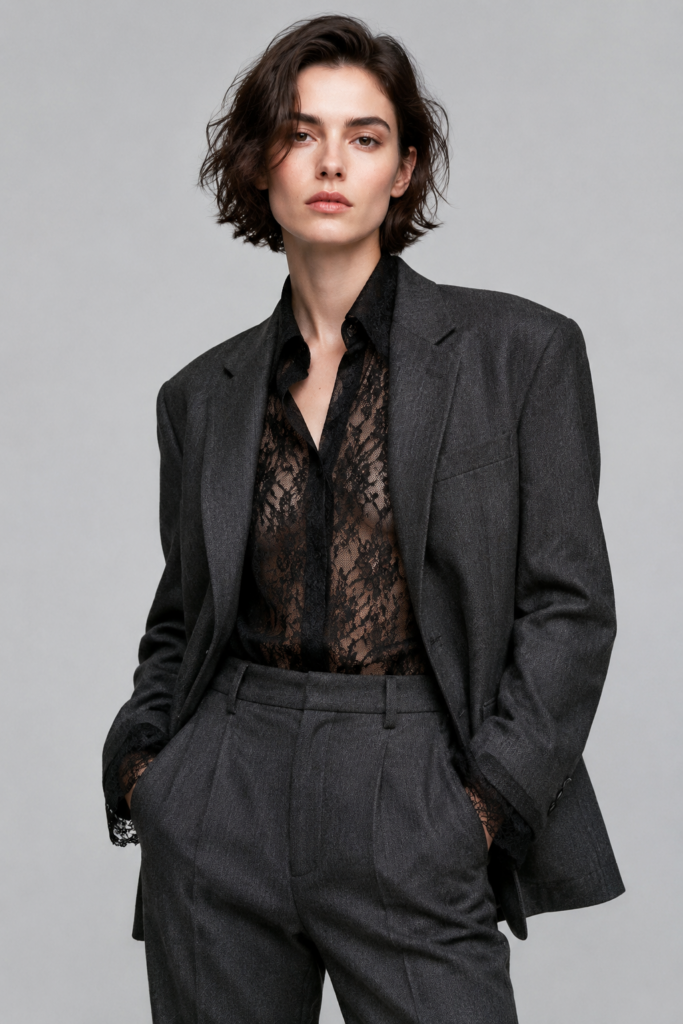
The answer depends on treating lace as a material rather than a personality. A lace-trim camisole under a charcoal suit does not make the suit “romantic”; it changes its density. A lace shirt over a cotton tank breaks up a block of denim. A lace skirt under a long knit or technical jacket adds movement without asking the whole outfit to become delicate. Even a narrow lace cuff beneath a poplin sleeve can do enough. The useful unit is often not the lace dress, but the lace layer.
Recent runway contexts support that broader reading. At Copenhagen Fashion Week’s Spring/Summer 2027 shows in August 2026, Harper’s Bazaar reported lingerie references, lace-trimmed layers and visible underpinnings alongside practical Scandinavian styling. At Paris couture in July, Vogue Scandinavia highlighted the extraordinary Carrickmacross lace work in Standing Ground’s collection as part of a wider emphasis on intricate craftsmanship. At the other end of the dress-code spectrum, Simone Rocha’s first dedicated menswear show placed lace tops beside leather outerwear and tailored pieces. Lace is not moving in one direction. It is being tested against workwear, tailoring, sportswear and masculinity.
This is why contrast is the most reliable styling method. There are three useful versions. First, lace with structure: a sheer lace blouse beneath a boxy blazer, a lace skirt with a crisp shirt, or a camisole under a chore jacket. Second, lace with utility: a fine top with cargo trousers, dark denim or a technical shell. Third, lace in small doses: a neckline, sock, scarf, inset panel or hem appearing beneath an otherwise simple outfit. In each case, the opposing fabric gives lace a job. Wool makes it lighter; denim makes it sharper; nylon makes it less nostalgic.
Color changes the message too. Black lace can be graphic rather than seductive when it is layered over an opaque black or white base. Ivory looks less bridal beside washed denim, tobacco brown, olive or grey. Chocolate, navy, burgundy and deep green lace can offer the same depth with less familiar symbolism. Bright lace works best when the silhouette is simple. Skin-tone matching is optional, not a rule: high contrast can be intentional on any complexion, while a closer tonal match creates a quieter, more continuous surface.
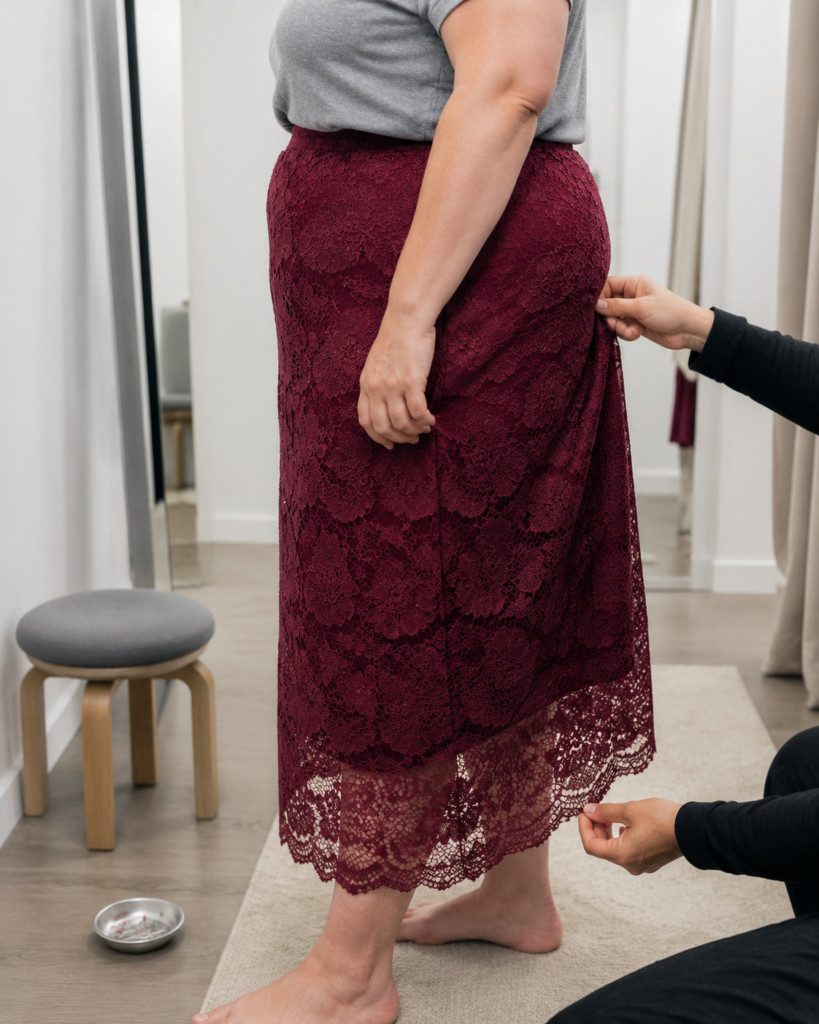
Fit requires more attention than the trend image usually admits. Lace has holes, edges and limited stretch, so placement matters. A high-neck lace top may need room through the shoulders and bust; a straight lace skirt may require a lining with enough ease to sit rather than climb. Petite wearers can keep the texture concentrated at a neckline, sleeve or shorter hem if a full layer feels overwhelming. Tall and plus-size wearers should not be pushed toward “small doses” by default: larger-scale motifs, longer panels and lace worn over a stable base can look particularly clear on a broader canvas. The issue is garment engineering, not whether a body is allowed delicacy.
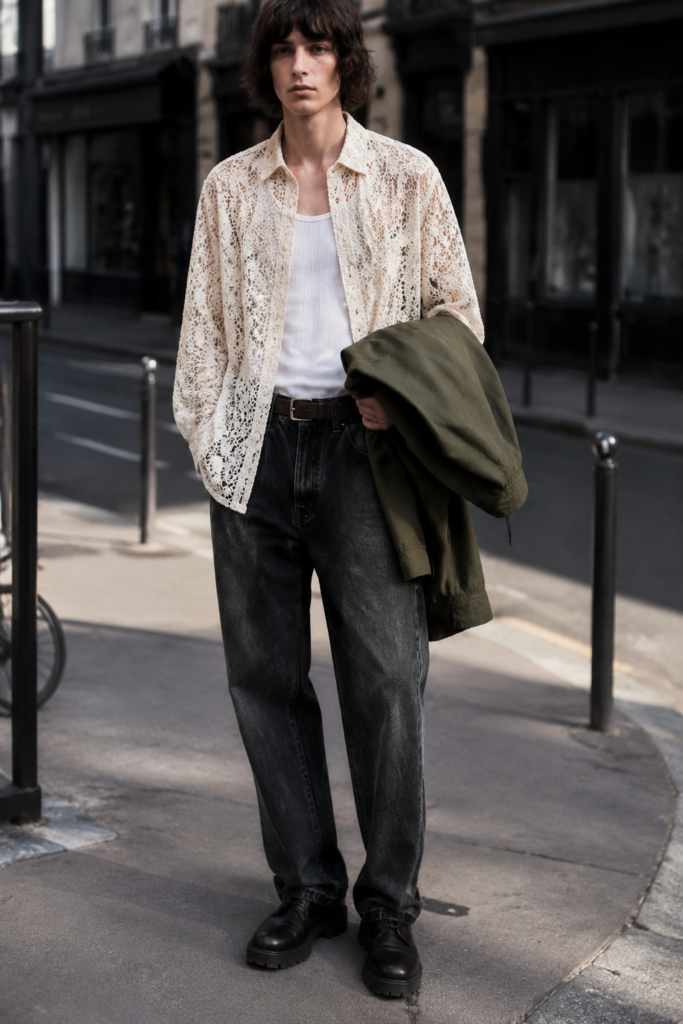
The same principle opens lace beyond womenswear. A lace shirt over a ribbed vest, a lace panel under a leather jacket, or a transparent knit with tailored trousers can work across gender expression because the styling is based on material tension, not a prescribed identity. Lace does not automatically feminize the wearer. It can expose, interrupt, ventilate or decorate, depending on cut and context. Rocha’s menswear is useful here not as a command to copy a runway look, but as evidence that softness and masculinity no longer need to be treated as opposites.
Climate should decide the construction. In hot, humid cities, an unlined cotton-lace shirt over a breathable tank may be more practical than polyester lace attached to a synthetic slip. Openwork can suggest ventilation without actually delivering it, especially when the lining traps heat. In cooler or rainy climates, lace earns more wear as an inner layer beneath knitwear, tailoring or weatherproof outerwear. Check fibre content, seam finish and care instructions: intricate-looking synthetic lace is not automatically fragile, while fine natural-fibre lace is not automatically suited to frequent washing.
That leads to the value test. Lace should not receive a free pass simply because it looks crafted. Before buying, inspect whether motifs meet cleanly at seams, whether the hem snags, whether the lining pulls, and whether the garment works with at least three opaque pieces already in the wardrobe. Vintage and resale can be strong options, but condition matters: brittleness, yellowing, broken threads and degraded elastic are more consequential in an open structure than on a plain woven fabric.
The shareable takeaway is simple: lace becomes easier to wear when it stops being the theme of the outfit. Give it one practical opposite – denim, tailoring, leather, cotton poplin or a technical fabric – and it can move from dinner to work, from summer heat to layered autumn, and across style identities. The contrast creates more possible wears than a fully romantic formula.
The return of lace is interesting not because fashion has rediscovered prettiness. It is interesting because a material burdened with old associations is becoming flexible again. The smartest lace outfit in 2026 does not ask the wearer to perform innocence, seduction or nostalgia. It lets texture do the talking, then lets the rest of the wardrobe answer back.