


Paris Haute Couture Fall/Winter 2026: Texture, Sculptural Form and Romance Lead the Season’s Most Wearable Takeaways
Paris Haute Couture Week Fall/Winter 2026–27 ran from July 6 to 9 across 30 houses, set against a Paris heatwave that made the escapism on the runways feel less like indulgence and more like necessity. This was a season defined by consolidation — sophomore
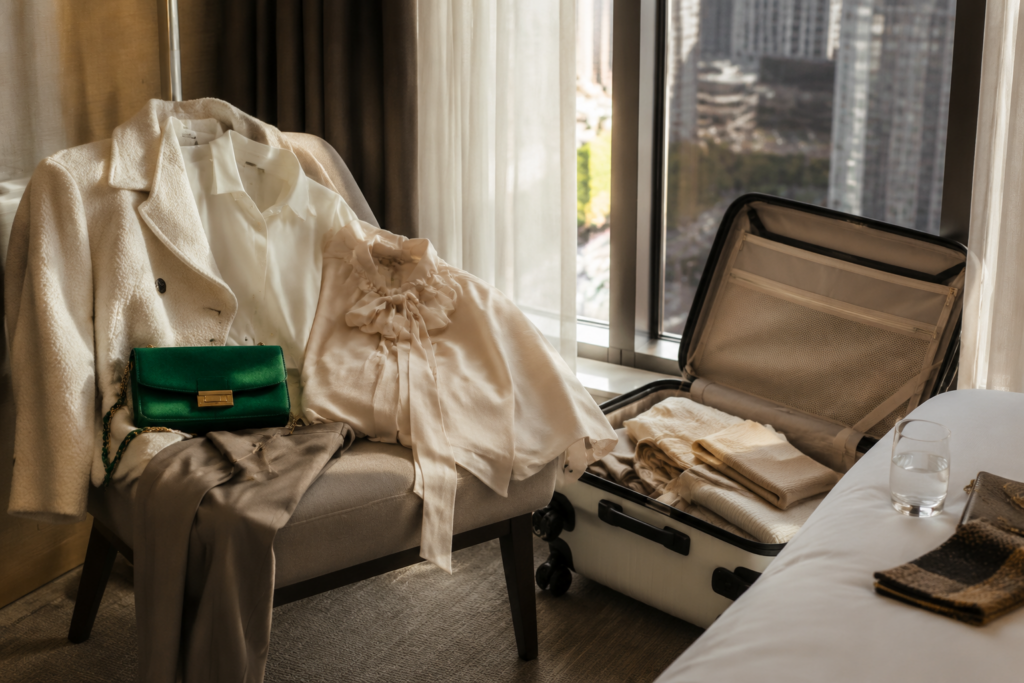
Paris Haute Couture Week Fall/Winter 2026–27 ran from July 6 to 9 across 30 houses, set against a Paris heatwave that made the escapism on the runways feel less like indulgence and more like necessity. This was a season defined by consolidation — sophomore collections from Jonathan Anderson at Dior and Matthieu Blazy at Chanel — and high-stakes debuts, most notably Pierpaolo Piccioli at Balenciaga and Duran Lantink as guest designer at Jean Paul Gaultier. But the real story was not who showed where. It was that couture, often dismissed as unwearable fantasy, produced some of the clearest styling directions for real-world dressing in recent seasons.
The signal came through four distinct but connected ideas that repeated across collections: texture replacing print as the primary surface interest, sculptural silhouettes that treat clothing as form rather than decoration, a return to romance and whimsy after years of disciplined neutrality, and bold accent colors deployed with strategic restraint. Each translates more readily into everyday wardrobes than the word “couture” usually implies.
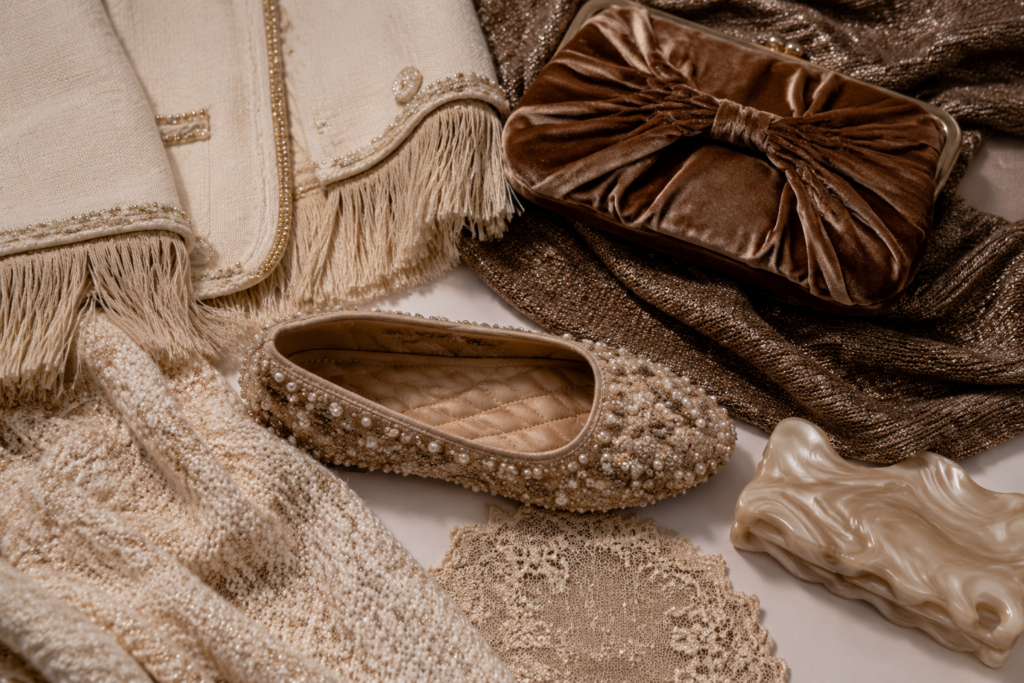
The most consistent message across the week was that fabric itself — its weight, sheen, hand-feel and dimensionality — has overtaken pattern as the primary source of visual interest. Daniel Roseberry at Schiaparelli layered surreal embroidery with silicone, latex and hand-moulded surfaces, including a closing look with a porcelain-effect silicone bustier worn by Zendaya in London hours after it left the Paris runway. Giorgio Armani Privé leaned into crystals, velvet and fringe. Standing Ground, the Irish label making its Paris debut at the Irish Embassy, featured Kristen McMenamy in a Carrickmacross lace gown reportedly requiring thousands of hours of handwork. The everyday takeaway is direct: let one tactile piece — a fringed jacket, a textured knit, a velvet bag, an embellished flat — carry the look while the rest stays quiet.
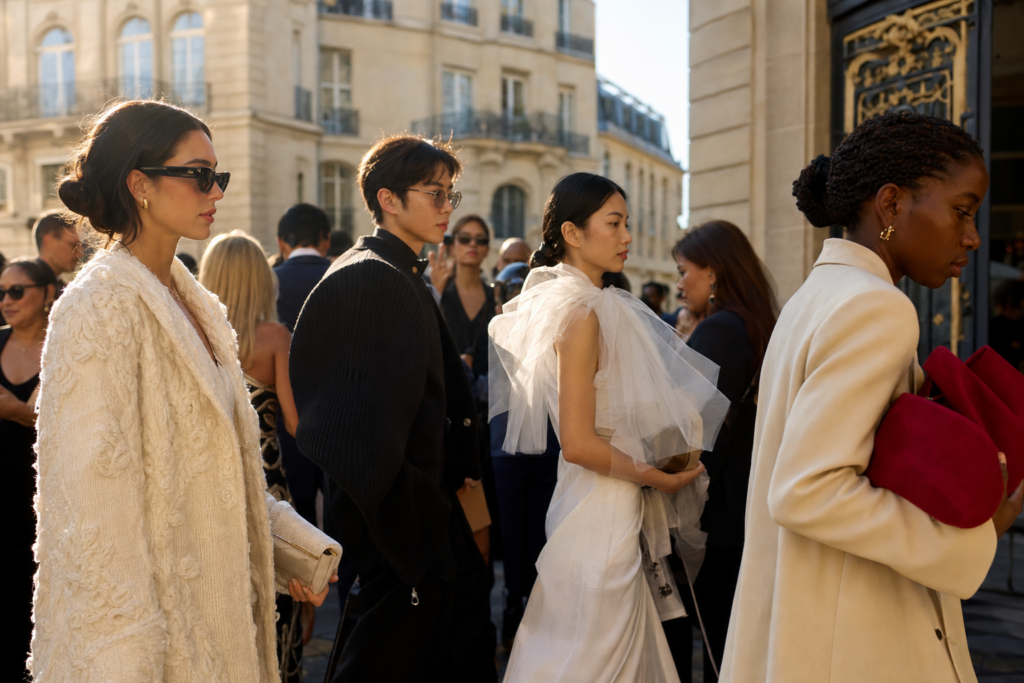
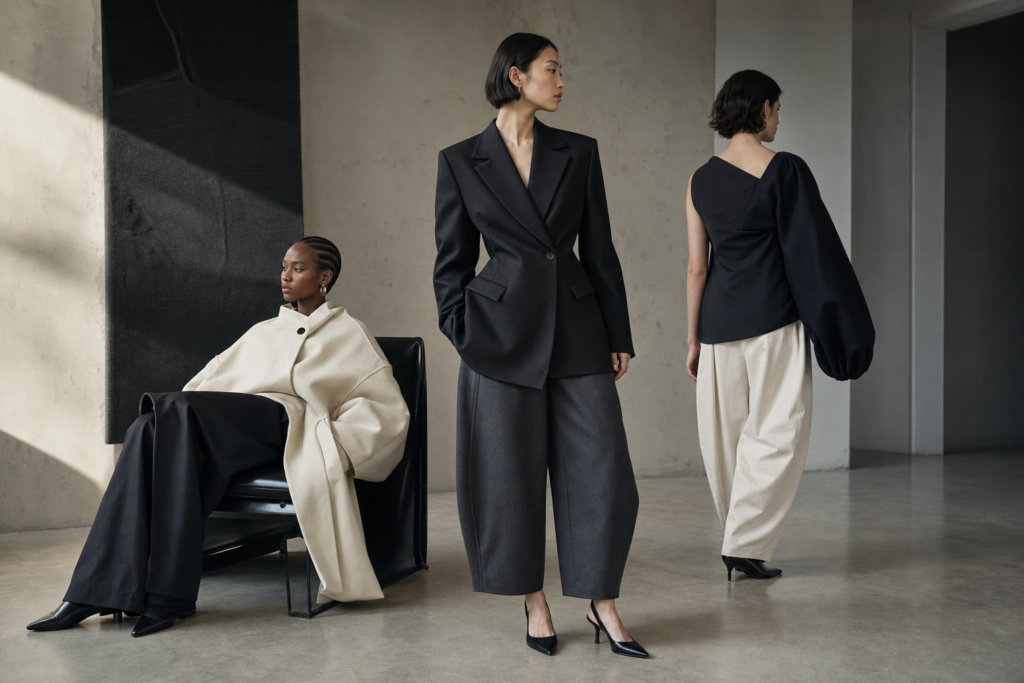
At Balenciaga, Piccioli used 3D body scans to construct inflated mannequins, producing balloon-hemmed gazar gowns and hooded feather cocoons that treated the body as architecture. His finale — Gigi Hadid engulfed in rooster feathers, and Piccioli taking his bow flanked by his entire atelier in white coats to a standing ovation — was the week’s most talked-about moment. At Dior, Anderson drew from American sculptor Lynda Benglis, creating garments that appeared poured rather than sewn: knotted, pleated and moulded into liquid-like volumes. For real dressing, the translation is practical rather than theatrical: a sharply structured blazer, a cocoon coat, a barrel-leg trouser, or an oversized sleeve adds one element of deliberate shape to an otherwise relaxed silhouette without turning the wearer into a walking sculpture.
If the past several seasons were defined by quiet luxury’s restraint — beige tailoring, no-logo discipline, the armor of neutrality — this couture week proposed a correction. Blazy transformed the Chanel presentation at the Grand Palais into a fairy-tale titled “Gaby and the Beanstalk,” complete with pea-pod heels, sleeping-bear minaudières and a swan-like gown that extended the show’s storybook mood. Elie Saab staged a masked ball inspired by Truman Capote’s 1966 Black and White Ball. Giambattista Valli delivered unabashed princess volume in tiered ruffles and tulle. The message is not that everyone should dress like a storybook character. It is that after years of disciplined neutrality, fashion is granting permission for softness and joy again — a ribbon detail, an embroidered floral piece, a silhouette that does not apologize for its volume.
Piccioli’s Balenciaga punctuated architectural black coats with saturated jewel tones — scarlets, cobalt blues, emerald greens — used one at a time with surgical precision. This was not rainbow dressing or the dopamine-brights trend of earlier seasons. It was color as punctuation: one crimson coat, one sapphire handbag, one pair of emerald pumps that transforms a neutral wardrobe without overwhelming it. For readers who have spent recent seasons building a base of beige, cream, black and grey, this is one of the easiest ways to add energy: one piece, one clear color, worn with everything already in the closet.
What makes these four directions relevant beyond the front row is that none of them demands a new wardrobe. Each operates as an edit: swap one printed piece for one textured piece, add one sculptural layer to a soft outfit, introduce one romantic detail into an otherwise practical look, wear one bold color against neutrals. The point is interpretation, not imitation. This is couture functioning less as an untouchable fantasy and more as a styling workshop — a reminder that how clothes are made and combined matters more than how many clothes one owns.
For international readers navigating heatwaves in Southern Europe, air-conditioned offices in New York, unpredictable summer layering in London or travel wardrobes that need to work across multiple climates, the couture message lands with unexpected practicality. A textured cotton coat works where a printed blazer feels loud. A sculptural linen shirt holds its shape through humidity. A single saturated accessory shifts the energy of a neutral travel wardrobe without adding bulk. These are not couture garments; they are couture ideas, filtered through real-life constraints of climate, comfort and cost-per-wear.
What to watch next: the Spring/Summer 2027 ready-to-wear season in September will reveal how many of these couture ideas survive translation to commercial fashion. Texture, sculptural volume, romance and strategic color are the four threads to track across New York, London, Milan and Paris. The Balenciaga, Dior and Chanel ready-to-wear collections will be the most scrutinized — not only for their creative direction, but for how they convert couture-level intensity into clothes people actually buy and wear.
In a season widely read as couture reclaiming its confidence after a difficult period for luxury, the most useful takeaway was also the simplest: fashion is allowed to be felt, shaped, enjoyed and worn — not just looked at.