

Summer 2026 Stripes Are Getting Bolder, More Vertical and Harder to Ignore
For most of modern fashion history, stripes have played a reliable but quiet role. The Breton top, the blue-and-white button-down, the pinstripe trouser — these were pieces readers reached for when they wanted to look pulled together without drawing attention. That version of stripes
For most of modern fashion history, stripes have played a reliable but quiet role. The Breton top, the blue-and-white button-down, the pinstripe trouser — these were pieces readers reached for when they wanted to look pulled together without drawing attention. That version of stripes is not gone. But summer 2026 is asking a different question: what happens when the print that once meant understatement becomes one of the season’s loudest style moves?
The answer is visible across platform search data, fashion coverage, retail floors and street-style images. Pinterest’s Summer 2026 Trend Report, which draws on behavior from over 600 million monthly active users, recorded a 1,962 percent increase in searches for “women’s striped shirt” and a 393 percent increase for “striped polo shirts.” Searches for “vintage sailor aesthetic” rose 385 percent. Those figures describe activity on Pinterest rather than the whole market, but they are still a strong signal: users are looking at stripes with unusual intensity, and many of the references gaining attention are not the quiet ones.
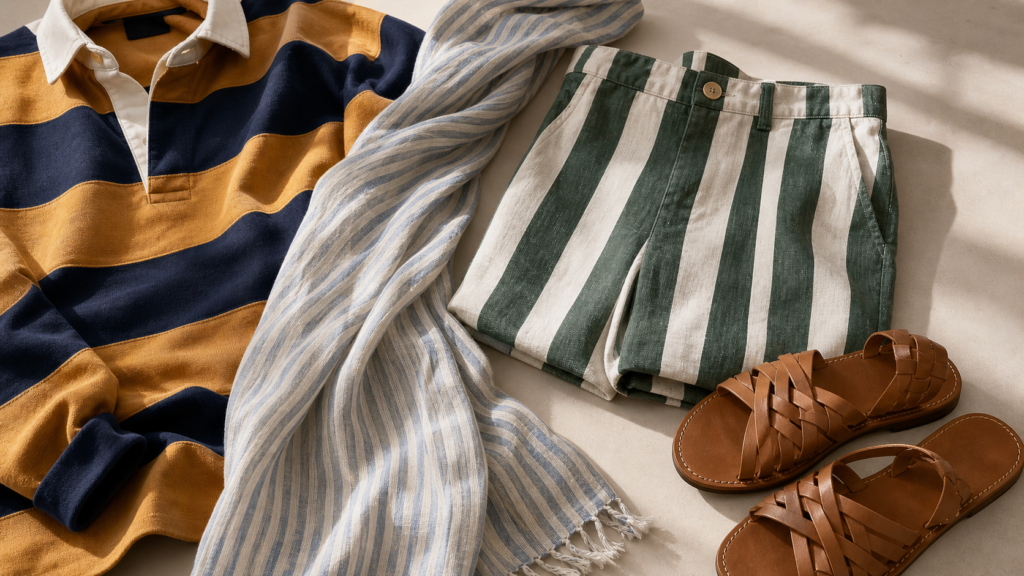
Three changes define the summer 2026 stripe. The first is direction. The classic Breton stripe runs horizontally across the body. The stripes gathering momentum now are more likely to run vertically, turning the print into a stronger architectural line rather than only a nautical accent. Loewe’s Fall/Winter 2026 pre-collection campaign, shot by Talia Chetrit on the volcanic terrain of Tenerife and released in May 2026, made green-and-white vertical deckchair stripes a central motif across scrunch-waist shorts, tailored shirts and accessories. The campaign treated stripes as a structural element rather than a decorative one, using them to build rhythm across the collection.
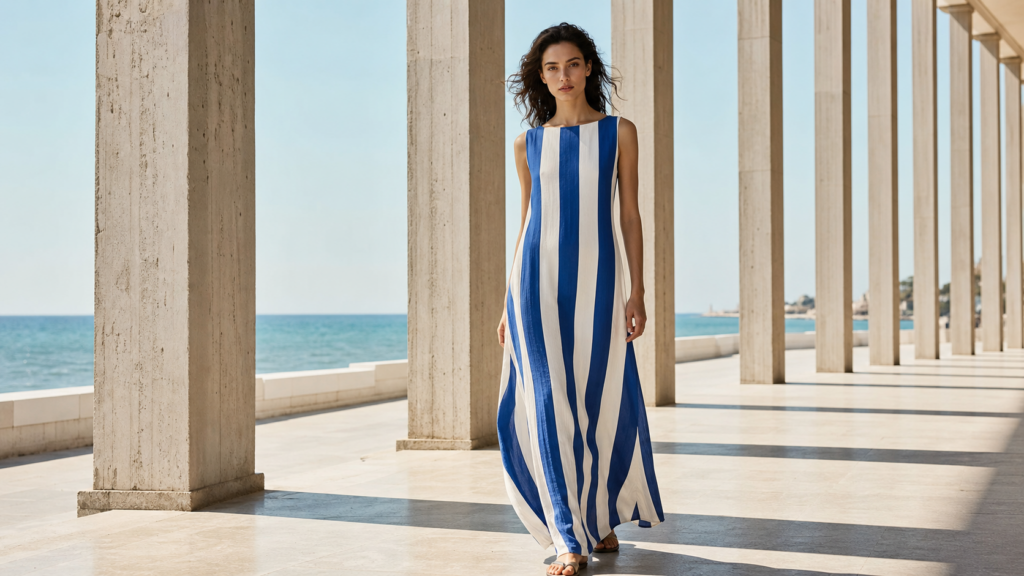
The second change is scale. Where the classic Breton uses fine, closely spaced lines, the season’s defining stripe is wide: the cabana stripe, named for the bold two-tone bands on poolside umbrellas and resort awnings. Byrdie described cabana stripes as a key pattern for summer style, framing them as an extension of the season’s broader appetite for holiday dressing and escapist style. Recent fashion coverage has also linked the stripe revival to resort, nautical and sport-inflected references, which helps explain why the print now feels less like a background basic and more like something that can carry an outfit.
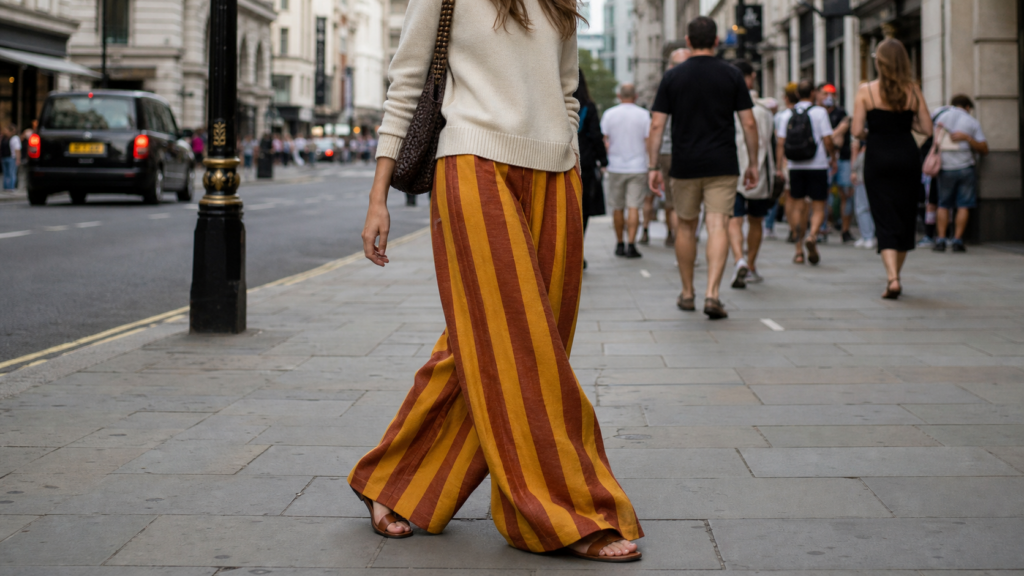
The third change is the most practical: stripes have moved from tops to entire garments. Where a striped shirt was once the obvious entry point, summer 2026 styling coverage is placing stripes across trousers, maxi dresses, co-ord sets, shorts and accessories. Marie Claire UK highlighted this broader range in its stripe-trend reporting, pointing readers toward trousers, dresses and layered striped pieces rather than only the familiar shirt. The stripe has expanded from an accent into a fuller wardrobe proposition.
Katie Holmes offered a useful street-level translation of how this trend lands in real life. In early June 2026, she was photographed in Manhattan wearing a slightly oversized blue striped button-down shirt, untucked, with dark-wash wide-leg jeans, brown leather toe-post kitten heels by Malone Souliers and a slouchy chocolate-brown leather tote. The look was not about maximalist stripes or runway drama. It was about stripes doing what they have always done well — making an outfit feel intentional without effort — but with proportions, shoes and accessories that felt current rather than nostalgic.
That tension between nostalgia and now is where the stripe trend becomes useful for international readers. Stripes are one of the few prints that cross climate, age, price point and dress code without needing translation. A cabana-stripe maxi dress can read as resort-ready in a coastal Mediterranean town, as holiday polish in Sydney, or as elevated weekend dressing in a Midwestern summer. A vertical-stripe trouser works for a London office with a blazer, for a Los Angeles dinner with a tank top, or for a humid Southeast Asian city in lightweight linen. Stripes adapt without losing their identity, and that adaptability is part of why the print is resonating in a season defined by personal taste rather than a single ruling aesthetic.
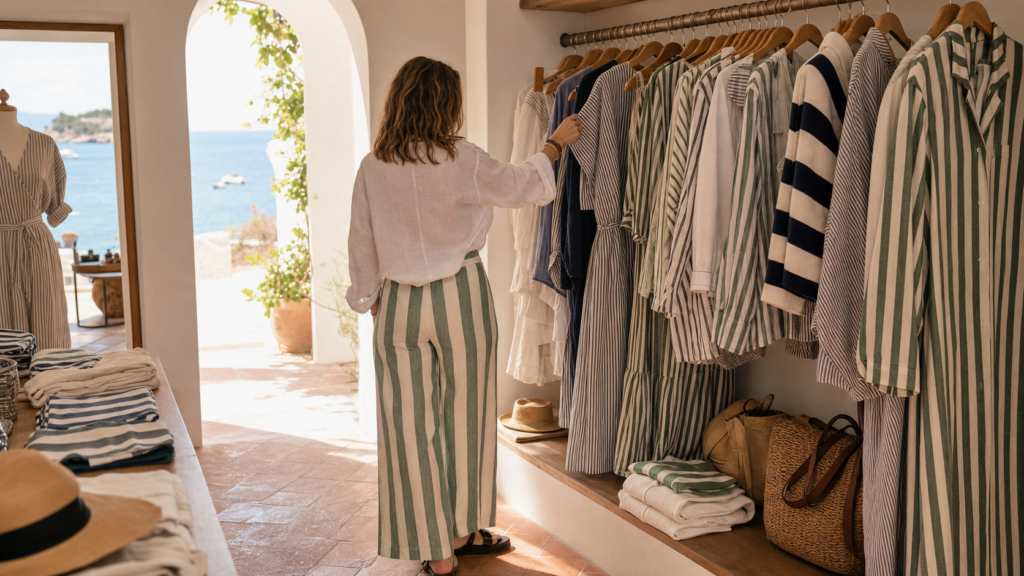
None of this means the Breton top is obsolete. The point is that stripes in summer 2026 have options they did not have a few seasons ago. A reader who wants the print can now choose its direction, scale, color palette and level of volume. That range makes stripes one of the more useful tools in a season where personal style is being treated as more interesting than trend conformity.
Pinterest frames the data as part of its wider trend methodology, and the platform says its predictions have reached an 88 percent accuracy rate over the past six years. That is Pinterest’s own measure rather than an independent audit, so it should be read as context rather than proof. Still, the stripe numbers sit inside a broader summer 2026 mood shaped by sport, nostalgia, coastal imagery and a renewed appetite for dressing with clarity — not quiet luxury restraint, but not chaos either. Stripes deliver structure with energy, which is exactly the balance many shoppers seem to be looking for.
The most useful takeaway is not that everyone should buy a cabana-stripe dress immediately. It is that stripes have moved from a safe default into a deliberate choice. Whether a reader chooses a wide vertical trouser, a colorful rugby top, a column of cabana-stripe linen or simply a well-cut blue striped shirt worn with good sandals, the print now carries more decisions inside it than it did when Breton was the only answer. That is a small but meaningful win for dressing with intention over dressing to fit a rule.